


When a new prescription drug enters the market, the question for employers isn’t just “does it work?”
It’s “what does covering it mean for our people, our plan, and our long‑term costs?”
That question became especially relevant in early 2026, when an oral version of Wegovy entered the market with widespread media coverage. With demand already high for injectable weight‑management medications, employers faced concerns about coverage.
At Capital Blue Cross, new drugs – whether they’re headline‑grabbing or quietly introduced – go through the same disciplined, repeatable review process. The goal is not speed or volume, but clarity: making sure coverage decisions are grounded in clinical evidence, value, and responsible use.
“Employers want consistency and predictability,” said Andy Dum, Director of Commercial Pharmacy at Capital Blue Cross. “They want to know are decisions made consistently and that those decisions are built around value, not noise.”
The Wegovy example offers a window into how that framework works.

Step one: Start with the medicine, not the price tag
Before cost or demand enters the discussion, Capital looks at clinical evidence.
For the Wegovy pill, that meant comparing it to the injectable version that is already on the market, reviewing safety data, and assessing whether the new option offered comparable health outcomes.
Capital gets help from independent, practicing clinicians who assess:
How well the drug works
How it compares to existing therapies
Whether it improves outcomes in a meaningful way
Only after the clinical picture is clear does the process move forward. This step helps employers trust that coverage decisions are driven by medical evidence – not marketing momentum.
Step two: View affordability as stewardship
Once the clinical value is established, Capital evaluates overall affordability. For a high‑demand therapy like Wegovy, that means considering:
Long‑term cost trends, not just short-term uptake
Whether alternatives offer similar outcomes at lower cost
Employers want predictable costs. By focusing on therapies that deliver the strongest return on outcomes, the goal is to keep coverage affordable with minimal impact on access.
Step three: Support access with guardrails
High‑visibility medications – especially GLP‑1s – can create pressure for immediate broad access. But true access also requires ensuring members are using the right drug for the right reasons.
The review of the Wegovy pill included determining:
What oversight is needed for safe, appropriate use
How to align clinical criteria with real‑world evidence
This balance helps employers avoid runaway costs while giving members access to therapies that genuinely improve health.
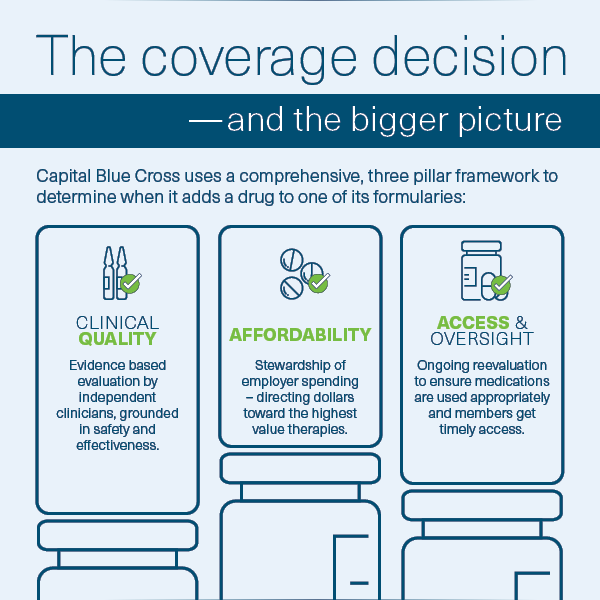
The final coverage call
After completing thorough clinical, affordability, and oversight evaluations, Capital Blue Cross decided to place oral Wegovy on the same formulary tier as the injectable version, reflecting comparable clinical value and similar expectations around appropriate use.
For employers that choose to cover Wegovy for weight loss, the decision applies consistently across both dosage forms. More importantly, the decision reflects something bigger than a single drug.
Every formulary decision at Capital follows the same framework – one designed to serve employers and members first, without competing financial incentives influencing the outcome.
“The move underscores Capital’s commitment to a straightforward, repeatable evaluation process,” Dum said. “Employers deserve consistency, members deserve clarity, and every coverage decision should be grounded in evidence. That’s how you build trust – and that’s how you keep pharmacy benefits sustainable over time.”